Integrated Pest Management (IPM) is a sustainable decision-making process that uses information on pest biology, environmental data, and technology to manage pest damage in a way that minimizes both economic costs and risks to people, property, and the environment.
About the Initiative: This is IPM
From food and farming to homes and communities, Integrated Pest Management (IPM) encompasses many settings, disciplines, and people, but this fact is not always apparent. This initiative aims to highlight the IPM network by demonstrating how real-world challenges are solved by real-life people implementing IPM.
This initiative began in 2022 with a national needs assessment to inform resource development and direction. The “This is IPM” website, social media channels, and companion podcast highlight the many IPM successes and impacts in food security as well as human health and wellbeing.
Highlighting the people and the process of Integrated Pest Management
What is IPM?
IPM uses knowledge of pest and host biology, as well as biological and environmental monitoring, to respond to pest problems with management tactics and technologies designed to:
Prevent unacceptable levels of pest damage
Minimize the risk to people, property, infrastructure, natural resources, and the environment
Reduce the evolution of pest resistance to pesticides and other pest management practices
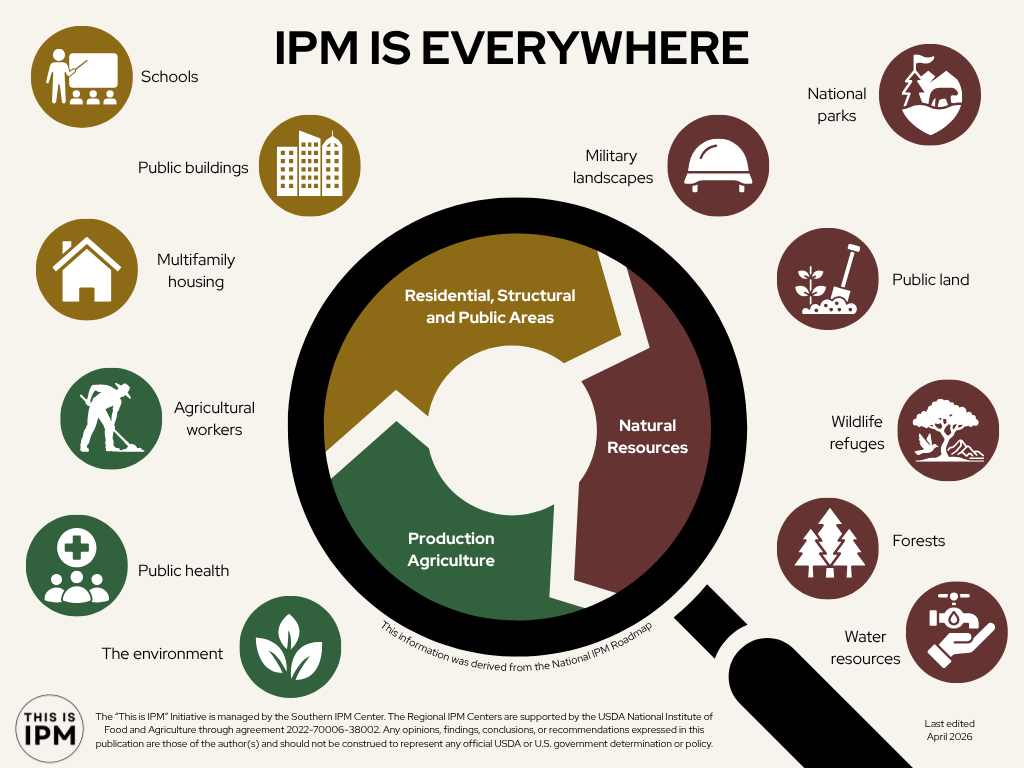
IPM provides effective, all-encompassing strategies for managing pests in all arenas, including all forms of agricultural production, military landscapes, public health settings, schools, public buildings, wildlife management, residential facilities, and communities. This also includes public lands including natural, wilderness, and aquatic areas.
What is IPM?
IPM uses knowledge of pest and host biology, as well as biological and environmental monitoring, to respond to pest problems with management tactics and technologies designed to:
Prevent unacceptable levels of pest damage
Minimize the risk to people, property, infrastructure, natural resources, and the environment
Reduce the evolution of pest resistance to pesticides and other pest management practices
IPM provides effective, all-encompassing strategies for managing pests in all arenas, including all forms of agricultural production, military landscapes, public health settings, schools, public buildings, wildlife management, residential facilities, and communities. This also includes public lands including natural, wilderness, and aquatic areas.
IPM Protects
Forests
Crops
Human Health
Homes and Schools
Regional IPM Centers
The Regional Integrated Pest Management (IPM) Centers serve as a hub for multi-state partnerships and communication networks, linking researchers, growers, extension educators, commodity organizations, environmental groups, pest control professionals, government agencies and others. The Centers help NIFA and its partner institutions identify, prioritize, and coordinate national pest management research, extension, and education programs.
Under the Crop Protection and Pest Management (CPPM) funding umbrella by the USDA National Institute of Food and Agriculture, the Regional Coordination Program (RCP) funds the Centers with a charge to:
Increase coordination and improve efficiency of IPM research and extension efforts
Facilitate collaboration across states, disciplines, and purposes
Promote further development and adoption of IPM
Through regional pest management information networks, collaborative team building, and broad-based stakeholder participation, we aim to more broadly implement research-backed results.
The CPPM program supports projects that will ensure food security and respond effectively to other major societal pest management challenges with comprehensive IPM approaches that are economically viable, ecologically prudent, and safe for human health. The outcomes of the CPPM program are effective, affordable, and environmentally sound IPM practices and strategies needed to maintain agricultural productivity and healthy communities.
I think agriculture is the ultimate solution for the growing world. That’s why I believe in making hay when the sun shines. It will eventually help us big time.
The “This is IPM” Initiative is managed by the Southern IPM Center. The Regional IPM Centers are supported by the USDA National Institute of Food and Agriculture through agreement 2022-70006-38002. Any opinions, findings, conclusions, or recommendations expressed in this publication are those of the author(s) and should not be construed to represent any official USDA or U.S. government determination or policy.