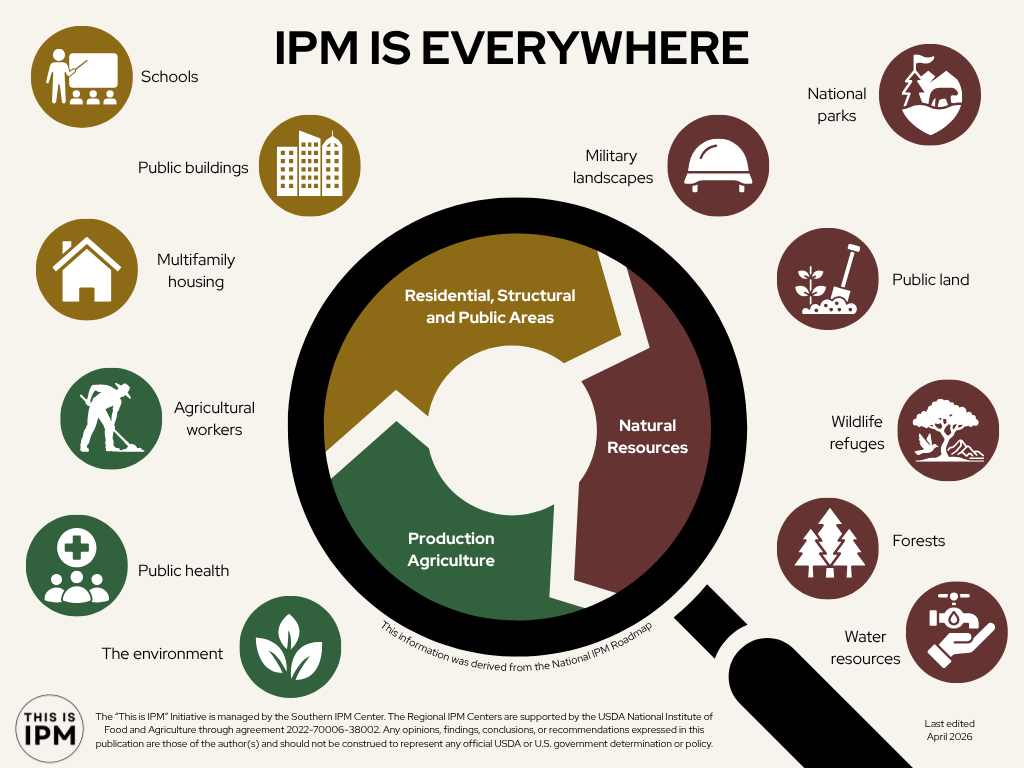
Search for items in the resource database, join Connect, see the latest infographics made by the This is IPM team, expand your network with IPM meetings, and see entities that are working hard in IPM.
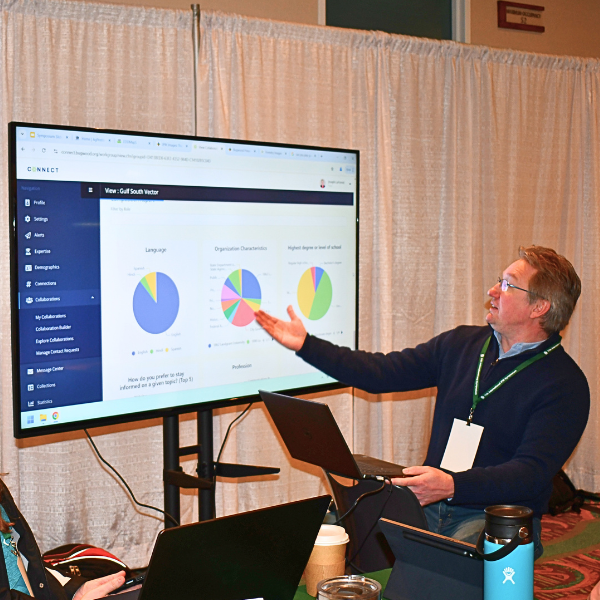
Joe LaForest, Southern IPM Center Co-Director, presents Connect Analytics at the 2025 IPM Symposium.
Resource Database
The IPM Resource Database is a contributor-generated content system for academic, non-profit, agency, and industry professionals to support program goals and outreach by facilitating easily accessible and trackable content. This database is a clearinghouse for resources on Integrated Pest Management and Invasive Species in all settings including Agriculture, Natural Areas, Forestry, Schools, and Urban Communities.
Search using the boxes below.
IPM is Connection
Connect is a platform used by Bugwood to manage user accounts and offer single sign-on. Tools for collaboration and community building, member management, content and data organization, and communication support working groups with outreach and program goals. Users and groups are also linked to their Bugwood Tools’ activity to track interactions, resource use, and measure impact.
Connect is a platform used by Bugwood to manage user accounts and offer single sign-on. Tools for collaboration and community building, member management, content and data organization, and communication support working groups with outreach and program goals. Users and groups are also linked to their Bugwood Tools’ activity to track interactions, resource use, and measure impact.
The IR-4 Project helps specialty crop growers address pest management concerns so they can produce healthy fruits, vegetables, herbs, and other crops recommended for a healthy diet; as well as flowers, shrubs, and landscape plants that enhance our environment.
The CPN enhances the visibility and success of agricultural extension while providing important crop protection information to farmers, agribusiness, and educators. Their goal is to communicate relevant information to farmers and agricultural personnel to help with decisions related to protecting alfalfa, corn, cotton, small grains, and soybean.
The mission of National Plant Diagnostic Network (NPDN) is to support plant health and biosecurity in U.S. agricultural and natural ecosystems by providing expert diagnostic capacity, communication, coordination, and quality pest and disease diagnostic information.
Sustainable Agriculture Research and Education (SARE) offers farmer-driven, grassroots grants and education programs. Since 1988, SARE grantees have been putting the principles of sustainable agriculture into practice on farms and ranches in every state and island protectorate.
The IR-4 Project helps specialty crop growers address pest management concerns so they can produce healthy fruits, vegetables, herbs, and other crops recommended for a healthy diet; as well as flowers, shrubs, and landscape plants that enhance our environment.
The CPN enhances the visibility and success of agricultural extension while providing important crop protection information to farmers, agribusiness, and educators. Their goal is to communicate relevant information to farmers and agricultural personnel to help with decisions related to protecting alfalfa, corn, cotton, small grains, and soybean.
The mission of National Plant Diagnostic Network (NPDN) is to support plant health and biosecurity in U.S. agricultural and natural ecosystems by providing expert diagnostic capacity, communication, coordination, and quality pest and disease diagnostic information.
Sustainable Agriculture Research and Education (SARE) offers farmer-driven, grassroots grants and education programs. Since 1988, SARE grantees have been putting the principles of sustainable agriculture into practice on farms and ranches in every state and island protectorate.
The Council for Agricultural Research, Extension, and Teaching (CARET) seeks to enhance national support and understanding of the land-grant university system’s food and agricultural research, extension, and teaching programs that enhance the quality of life for all people.
The Office of Pest Management Policy (OPMP) is responsible for communicating across federal agencies to promote the development of pest management strategies that reduce the economic, environmental, and public health risks from pests as well as from the methods used to control them in agricultural and natural resource environments.
The Bugwood Center at the University of Georgia develops and utilizes partnerships and information technology to advance invasive species management, integrated pest management, and forest health.
The Extension Disaster Education Network (EDEN) reduces the impact of disasters by bringing together and coordinating the expertise and resources of the Cooperative Extension System to address the critical needs of individuals, families, and communities.
The Council for Agricultural Research, Extension, and Teaching (CARET) seeks to enhance national support and understanding of the land-grant university system’s food and agricultural research, extension, and teaching programs that enhance the quality of life for all people.
The Office of Pest Management Policy (OPMP) is responsible for communicating across federal agencies to promote the development of pest management strategies that reduce the economic, environmental, and public health risks from pests as well as from the methods used to control them in agricultural and natural resource environments.
The Bugwood Center at the University of Georgia develops and utilizes partnerships and information technology to advance invasive species management, integrated pest management, and forest health.
The Extension Disaster Education Network (EDEN) reduces the impact of disasters by bringing together and coordinating the expertise and resources of the Cooperative Extension System to address the critical needs of individuals, families, and communities.
The Pesticide Environmental Stewardship (PES) provides convenient access to information on proper pesticide handling with all subject matter reviewed and posted by Pesticide Safety Education Program Coordinators and Specialists from the Cooperative Extension Service. The website is intended for a national audience with links to state-specific information for an audience of crop producers, pesticide dealers, commercial/professional applicators, and the general public.
The Minor Use Animal Drug Program (MUADP) is designed to address the shortage of minor use animal drugs by funding and overseeing the efficacy, animal safety, and human food safety research and environmental assessment required for drug approval. The scope of the program includes animals of agricultural importance and generally excludes companion animals.
The National Animal Health Laboratory Network (NAHLN) is a network of animal disease diagnostic laboratories that provides ongoing disease surveillance, responds quickly to disease events, communicates diagnostic outcomes to decision makers, and has the capability and capacity to meet diagnostic needs during animal disease outbreaks.
The Center for Integrated Pest Management (CIPM) at North Carolina State University partners with numerous federal, state, international and industry stakeholders in over 40 projects to develop innovative solutions and address challenges of invasive and domestic pests. Our current project areas include Regulatory Pest Informatics, Strategic Pest Management, and Social-Ecological Pest Analytics.
The Pesticide Environmental Stewardship (PES) provides convenient access to information on proper pesticide handling with all subject matter reviewed and posted by Pesticide Safety Education Program Coordinators and Specialists from the Cooperative Extension Service. The website is intended for a national audience with links to state-specific information for an audience of crop producers, pesticide dealers, commercial/professional applicators, and the general public.
The Minor Use Animal Drug Program (MUADP) is designed to address the shortage of minor use animal drugs by funding and overseeing the efficacy, animal safety, and human food safety research and environmental assessment required for drug approval. The scope of the program includes animals of agricultural importance and generally excludes companion animals.
The National Animal Health Laboratory Network (NAHLN) is a network of animal disease diagnostic laboratories that provides ongoing disease surveillance, responds quickly to disease events, communicates diagnostic outcomes to decision makers, and has the capability and capacity to meet diagnostic needs during animal disease outbreaks.
The Center for Integrated Pest Management (CIPM) at North Carolina State University partners with numerous federal, state, international and industry stakeholders in over 40 projects to develop innovative solutions and address challenges of invasive and domestic pests. Our current project areas include Regulatory Pest Informatics, Strategic Pest Management, and Social-Ecological Pest Analytics.
A nationwide system of agricultural research stations operated under the auspices of the nation’s Land-grant universities and dedicated to the science that feeds the world.
ECOP is the representative leadership and governing body of the Cooperative Extension System, the nationwide transformational education system operating through land-grant universities in partnership with federal, state, and local governments.
A nationwide system of agricultural research stations operated under the auspices of the nation’s Land-grant universities and dedicated to the science that feeds the world.
ECOP is the representative leadership and governing body of the Cooperative Extension System, the nationwide transformational education system operating through land-grant universities in partnership with federal, state, and local governments.
The “This is IPM” Initiative is managed by the Southern IPM Center. The Regional IPM Centers are supported by the USDA National Institute of Food and Agriculture through agreement 2022-70006-38002. Any opinions, findings, conclusions, or recommendations expressed in this publication are those of the author(s) and should not be construed to represent any official USDA or U.S. government determination or policy.